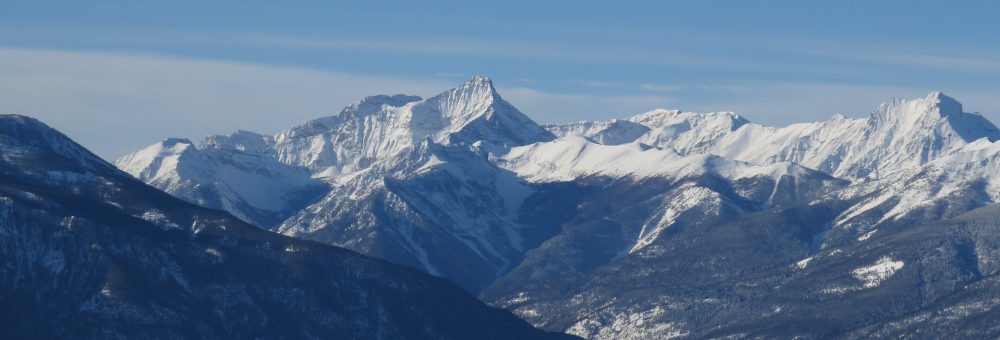
Mount Wardle, Wardle Creek (Kootenay National Park)
In late 1919 Wardle was appointed to take over supervision of the Banff-Windermere Highway. … While the agreement stipulated that the road be completed in 1924, Wardle himself drove the first automobile over the road in September 1922.
The Banff-Windermere Highway was opened to the public on 23 June 2023. The last post on Harry Haffner discusses the first engineer in charge of constructing the road. This week we look at the life of James Morey Wardle, the engineer who saw the job done.
The Wardle Family
James Morey Wardle was a B.C. born boy who went on to become not only an influential Canadian engineer, but a federal government minister.
James’ parents were both early arrivals to British Columbia, arriving when the province was still a young colony. James’ father, James Wardle, arrived in 1866 at the tail end of the Cariboo Gold Rush (1861-67).1 He became a well-known merchant in Hope, but also worked at times as a mail agent and as an ‘express man’.2 For the decade between 1872 and 1882 Wardle held the contract for delivering mail from Victoria to Wild Horse Creek (near present-day Fort Steele) in Kootenay. That contract required six trips per year along the Dewdney Trail, the travel corridor built across lower southern B.C. in the wake of the Wild Horse Gold Rush. Those trips (via horse) would not have been easy, but neither was receiving mail only once every two months or so!3
James Morey Wardle’s mother, Martha Mary Morey, was a long time resident of B.C. by the time James Wardle arrived. She arrived in B.C. at age just two years old with her parents, Jonathan and Frances Morey, after the family sailed from Gravesend in England on 30 October 1858, around Cape Horn, and arrived at Esquimalt on 12 April 1859. Sometime during the six month voyage, Martha’s younger sister (Marina) was born: she was one of five children born en route.4
This particular voyage came in the immediate wake of the Fraser River Gold Rush, and the vessel the Moreys sailed on was full of Royal Engineers and their families. Martha’s father, Jonathan, was a Sergeant. The Royal Engineers were sent to the newly formed colony of BC to instill a British presence there and, despite their name, they had both a practical and military purpose, their duties including policing the goldfields, surveying townsites, and constructing roads.5
The Moreys stayed on in the colony after the Royal Engineers were disbanded in 1863, living in New Westminster where Jonathan worked as a caretaker for the Hyack Hall (where the town bell was located).6 (Read more about the rather popular and far reaching Chinook word “Hyak” in this post about a local steamboat of that name).

Martha Morey, who married James Wardle in 1877, [187-?], Record ID 39233, British Columbia Pioneers collection, New Westminster archives, http://archives.newwestcity.ca/permalink/39233/
James Wardle and Martha Morey were married on 24 October 1877 in New Westminster, settling in Hope where they began a family.7 Our James Morey was the fourth of five children, born 26 June 1888: like his siblings he was baptized at St Johns Church in Hope, one of the early Anglican churches in the province and one that is still standing!8

“St. John’s Church, Yale,” c.1893, Item D-01645, BC Archives, https://search-bcarchives.royalbcmuseum.bc.ca/st-johns-church-yale-4.
The Wardle Family
Our Wardle, James Morey Wardle, was named after both of his parents. He grew up in Hope with his two elder sisters (Ethel Glover and Mattie Hope Sarah),9 and one elder brother (Robert Henry).10 When James was around age nine, another brother (Arthur Coppen) also came along.11
James seems to have patterned his early career after his eldest sister, Ethel. When Ethel was age eighteen or so, she got her Public School Teaching Certificate,12 and the following year (1899/1900) she became the teacher in Hope. Ethel stayed at the Hope school until the end of the 1901 year,13 the same year that her younger brother, James, one of her pupils, passed his high school entrance examinations.14
James attended high school in New Westminster Centre where he did quite well: he received his high school certificate for the junior grade in July 1903,15 and in 1905 was awarded a Silver Medal by the Governor General in his written examinations.16 Following in his sister’s footsteps, James went on to gain his own teaching certification, taking the advanced session in 1905/1906 to gain a First Class Certificate in 1906.17
Ethel had also continued teaching for a time in Harrison Hot Springs,18 before moving on to a school in New Westminster. When her brother got his first job in Lytton in the 1906/07 school year, Ethel (working in the city with eight years of experience) was being paid $52.50 a month.19 James’ starting wage was $60 a month.20 Ethel would remain a teacher until August 1909, when she married clerk Hugh Lleyellyn Jones.21
James, meanwhile, stayed at Lytton for two school years (until the end of term in 1908),22 after which he began attending Queen’s University studying engineering. Both James and Ethel continue to be listed as having active First Class teaching certificates in BC until the end of the 1915-16 school term, despite neither seeming to do further teaching work.23
Early Engineering Career
Having committed to studying engineering, Wardle certainly dedicated himself to the task. As later recounted, during the same 1908 to 1912 period in which Wardle studied civil engineering at Queens, he was also on location in the lower Fraser River Canyon working as a draughtsman for the construction of a Canadian Northern Pacific Railway. Immediately after graduation, then, J.M. Wardle had the experience (and the connections) to become the municipal and town engineer in Chilliwack, working on land surveys, highway location, drainage, and waterworks.24
The Chilliwack position did not last long, as in spring 1913 Wardle began living in Ottawa, where he started working for the Department of the Interior for the federal government, specifically with the Canadian Parks Branch on topographical surveys.25 This was the beginning of a long career with Parks on a wide variety of projects. Among these early efforts, in July 1915 Wardle worked under locating engineer Andrew Wellington Gray to survey the road up to the summit of Mt Revelstoke.26 Much later, and after a number of realignments, this remains the Meadows in the Sky Parkway.
This was also a time for changes in Wardle’s personal life. In November 1913 Wardle married fellow Queen’s graduate Maud Leette Roney in Kingston, Ontario.27 The two would go on to have one daughter (Dorothy Hope) in 1919.28
The First World War
James M. Wardle’s career was strongly influenced by the First World War, but not necessarily for the reasons one might expect. The last blog post on Harry Haffner, also a young and promising engineer working in British Columbia, saw Haffner join up and die on the battlefield. Wardle, on the other hand, despite being young (not yet thirty years old) and with specialized skills as an engineer, chose not to enlist. This was not a popular decision. Young men in particular were socially expected to serve for King and Country; after the War ended, returned service men were often hired preferentially, particularly by other returned service men.
This doesn’t mean that Wardle got through the war unscathed (few did). In May 1917 Wardle’s younger brother, Arthur Coppen, then also suffering a case of trench foot, was killed in action overseas.29
Still, Wardle’s decision not to enlist certainly helped along his career, particularly after his immediate superior, Andrew Wellington Gray, enlisted. Gray had signed up in January 1915, and went overseas in July 1916,30 leaving Wardle to take over as acting Chief Highways Engineer for the Parks Service. Wardle’s subsequent work tended strongly towards highway construction, including overseeing work through summer 1916 on the road between Castle Junction and Lake Louise (using internment labour from the Castle Mountain camp),31 and work on roads up in Jasper.32
This road engineering work took a brief pause after 1 July 1918 when J.M. Wardle was appointed to the position of Superintendent of Rocky Mountains Park (now Banff National Park). The existing system of appointing candidates based on patronage – essentially through politics – was abolished by the Dominion Government in November 1917, leaving a path open for appointment based on merit.33 In the Journal of the Engineering Institute of Canada, it is remarked how Wardle’s background as an engineer would aid in the large number of construction works that he would be supervising.34
While the appointment to Superintendent was greeted positively by his engineering colleagues, the townspeople of Banff were less enthused. Banff had a high enlistment rate in the war, so having a (young) Superintendent – arguably the most influential position in the town – who had chosen not to serve would have been highly unpopular. Wardle’s position lasted less than a couple of years: in 1920 he was back as a construction engineer for the Parks Branch.35 By that time, the war was also over.
Friends in High Places
Wardle’s ouster from the Superintendent position wasn’t all that much of a problem for his career, however, particularly given his positive working relationship with the head of the Parks Branch, J.B. Harkin. Appointed as the first Commissioner of the newly formed Parks Branch in 1911, Harkin had a huge amount of influence (both physically and politically) in shaping the Canadian National Parks. He relied on reliable employees, and Wardle very quickly became one of his trusted go-tos: by the time Wardle was appointed to Superintendent in Banff, he had become Harkin’s “main Banff confident.”36
Even before his job as Superintendent of Banff was over, then, in late 1919 Wardle was appointed to take over the supervision of the Banff-Windermere Highway. The provincial and federal governments had come to an agreement in March 1919 for the feds to construct the road in exchange for land from the province: land that would become Kootenay National Park.
Wardle’s experience in both highway construction and surveying came in handy in this position, as did his willingness “to adopt improved methods and techniques.”37 “An energetic and highly organized individual, he instigated two changes that proved vital to the road’s timely completion,” working in the winter on clearing the right of way, and using day labour over contract work.38 Wardle was also pretty good at saving money, changing the survey in places in the Vermilion valley, “missing hug rock cuts, following natural benches, etc, [and]… sav[ing] the Dominion thousands of dollars.”39

The Banff-Windermere Highway slowly takes shape, here on the lower slopes of what would later be named Mt Wardle.
“Crew building Banff-Windermere, Kootenay National Park,” 1920, A 282, Windermere Valley Museum and Archives.

Construction of the Banff-Windermere Highway, a road built for automobile travel, was done almost entirely with horse and manual labour.
“Road construction crew with horse teams working on Banff-Windermere Highway,” 1921, A889, Windermere Valley Museum and Archives.
While the federal/provincial agreement stipulated that the road be completed in 1924, Wardle himself drove the first automobile over the road in September 1922: a trip that took seven hours from Banff to Invermere.40 The highway was not opened to the automobile driving public until June 23, 1923, at an elaborate ceremony at Kootenay Crossing.

A collection of important guests at the opening of the Banff Windermere Highway – I’m fairly certain that’s J.M. Wardle forth from the right on the stage.
“Platform guests at Banff-Windermere Highway opening, Kootenay National Park,” 1923, A703, Windermere Valley Museum and Archives.

“Automobiles parked for opening ceremony for the Banff-Windermere Highway at Kootenay Crossing,” 1923, A701, Windermere Valley Museum and Archives.
Some More Photos of Highway Construction

A work crew on the Banff-Windermere Highway. From other photos, it’s likely that the shovels were used to dig the holes for dynamite to blast loose the right of way.
“Sinclair Section – Sta. 145 (approx),” October 1919, Accession No 1979-195 NPC, Box 14, page 6, e011313940, Library and Archives Canada, http://central.bac-lac.gc.ca/.redirect?app=fonandcol&id=5722196&lang=eng

This view in may look vaguely familiar: the current tunnel would be just around the corner going down into Radium. The amount of work done up to Sinclair Pass is easy to forget given how straight-forward the route is over 100 years later!
“Rock Cut-Sta. 140, Looking West,” 15 May 1920, Accession No 1979-195 NPC, Box 14, page 53, e011313918, Library and Archives Canada, http://central.bac-lac.gc.ca/.redirect?app=fonandcol&id=5723668&lang=eng

Hard to imagine a semi-truck passing through! The first road was certainly not wide as is curved up along Sinclair Creek.
“Automobile on Banff-Windermere Highway in Redstreak Canyon,” c.1923, A888, Windermere Valley Museum and Archives.

The newly completed Banff-Windermere Highway was designed as a scenic route, taking advantage of tree lined corridors framing the mountains in the distance.
Byron Harmon, “648. Banff Windermere Highway,” [before 1942], Peel Prairie Postcards, http://peel.library.ualberta.ca/postcards/PC007547.html
Chief Engineer of Parks
Wardle’s career, meanwhile, continued to skyrocket. Even before the Banff-Windermere Highway was completed, back in late 1921 Wardle was appointed chief engineer for the National Parks.41 In this position, Wardle would go on in 1927 to oversee the completion of the Kicking Horse Trail between Lake Louise and Golden.42
Just a few years later, Wardle was put in charge of supervision on the “East Leg” of the Big Bend Highway, which followed the Columbia River north from Golden and all the way around to Revelstoke.43 The work project was approved on 30 September 1929, and was carried out in the early thirties. It included a number of ‘relief camps’, and gave work to unemployed men (including many from the Windermere Valley).
In September 1935 Wardle had just completed work on the “East leg” (north from Donald to Boat Encampment), had been put in charge of work on the “West leg” from Revelstoke north, and had begun supervision of what would become the Icefields Parkway (Lake Louise to Jasper), when he received a rather significant promotion to Deputy Minister of the Interior.44 Once serving under Commissioner J.B. Harkin, the (still young) Wardle was now his superior.
Life in the Public Service
Wardle did not stay Deputy Minister for long, even though he very much stayed among the upper echelons of the Public Service. After only about a year, in October 1936 he was appointed as Director of Surveys and Engineering Branch of the (then) newly formed Department of Mines and Natural Resources.45 This included serving as the director of “special projects” for the Department (the Department of Mines was then the overarching agency for the Parks Branch as well, so Wardle continued to have influence on work in the National Parks).46
Wardle’s expansive work continued, and in 1939 he was one of three Canadian members of an International Point Commission to study the proposed construction of the British Columbia to Alaska Highway.47 The highway work continued. Through the Second World War, Wardle was involved in constructing a road between Prince Rupert and Hazelton.48
He also organized construction on the Hope-Princeton Highway (roughly along some of the Dewdney Trail route his father used to deliver mail to the Kootenays in the 1870s). This work was delayed, much to Wardle’s disappointment, “because not enough Japanese are willing to work on it.”49 It must be noted that the reported 225 Japanese-Canadians that were then working on the road would have been among those interred in camps in the interior of BC during the Second World War: it is not particularly surprising that internees were reluctant to undertake strenuous physical labour for a country that took away their freedom and physical property.
Following the war, still in his position with the Department of Mines and Resources, J.M. Wardle was appointed the Canadian member of the International Boundary Commission, which had been set up to mark various parts of the boundary with the United States and to maintain an effective boundary line.50 He was also then still a part of a committee to study the construction of the Alaska Highway.51
Sometime between 1948 and 1950, Wardle was appointed as Director of the Engineering and Water Resources Branch in the Department of Resources and Development (the presumed successor to the Department of Mines).52 He retired from that position and from the public service on 12 May 1952.53
Consulting Work
Just because he was done at the public service didn’t mean that Wardle was quite done with work. From 1953 he was engaged in “consulting work”,54 for Northwest Power Industries Limited and Frobisher-Quebec Metallurgical Industries, and was the Canadian Consultant for Sir Alexander Gibb and Partners, London Eng.55
Wardle was also asked to survey and report on the development of provincial parks in Alberta at Vermilion, Little Bow and Cypress Hills.56 In 1957 he was a consulting engineer “on the great Yukon River Power project,”57 and in 1959 was on a Commission for the “orderly development and improvement” of the National Capital region of Ottawa and Hull.58 Perhaps less prestigious, but rather curious, Wardle received a patent in 1961 for “a spiral water “staircase” for salmon”, providing a series of steps/pools for both spawning salmon and their returning fingerlings to get past a dam. The rights for the patent were assigned to Northwest Power Industries Ltd, Ottawa, whom he was consulting for.59
This is, perhaps unsurprisingly, only an overview of a selection of projects that Wardle was involved in: his work in various departments would have been vast, particularly in the very busy and influential post-war years in Canada. Even alongside his departmental duties, he was also at times involved with the Engineer Institute of Canada,60 the Northwest Territories Power Commission, and the Eastern Rockies Forest Conservation Board.61
Wardle also maintained advocacy for the completion of the Trans-Canada Highway. In January 1951 he urged publicly that the highway, “should be built for the future so that changes or improvements will not have to be made almost immediately after it is finished…. “Are we going to build sections of this highway this year or next year that will be just right for 1956 (the year it is scheduled for completion), or even a little obsolete, or will be right in 1965?””62
This was a period in which a huge amount of money was being devoted across the country to building/upgrading the Trans-Canada route, and Wardle’s advocacy and involvement in the project at key moments led to his sometimes being referred to as the “father” of the Trans-Canada Highway.63 The final link in the “new” Trans-Canada was opened through the Rogers Pass in 1962.
Life Outside Work
Despite his various commitments, Wardle did maintain a life outside of work. He, his wife Leette, and their daughter Dorothy (also a Queens graduate, Arts 1942) all maintained a close connection to the town of Banff. Wardle was one time the president of the Trail Riders of the Canadian Rockies, and a “leading stalwart” in the Trail Hikers.64 He was also president of the newly formed Banff Rotary Club in January 1925.65 It is telling that all three Wardles are interred at the Old Banff Cemetery and that, despite a long an rather influential career in Ottawa, the Wardle family papers are housed at the Whyte Museum of the Canadian Rockies in Banff.66
James Morey Wardle passed away 18 May 1971 in Calgary, being predeceased by his wife on 1 December 1969.67
The naming of Mt Wardle, meanwhile, came relatively early in Wardle’s career, in 1928, when Wardle was (merely) a lowly engineer, in recognition of his work on the Banff-Windermere Highway.68 If you’ve driven through Kootenay you’ve seen it, and if you’re lucky you’ve seen members of its resident flock of mountain goats as you drive alongside its base past Hector Gorge.

Mount Wardle is a prominent feature on the easterly drive through Kootenay National Park.
Terry Ott, “Dramatic look up at Mt Wardle [right]… and Mt Verendrye [left] in Kootenay National Park,” 26 September 2022, CC 2.0 Creative Commons, https://www.flickr.com/photos/terryott/52418596747/.
See Also
Hector Gorge
Harry Haffner
Hyak (steamboat)
Banff Windermere Highway (Promotional Pamphlet)
 In The Windermere
Another fascinating story, really great work. So this is the 100th anniversary of the Banff-Windermere Highway…there should be some acknowledgement if there isn’t already.
LikeLike
Thanks! Yes, I agree, it would be nice to see some recognition.
LikeLike