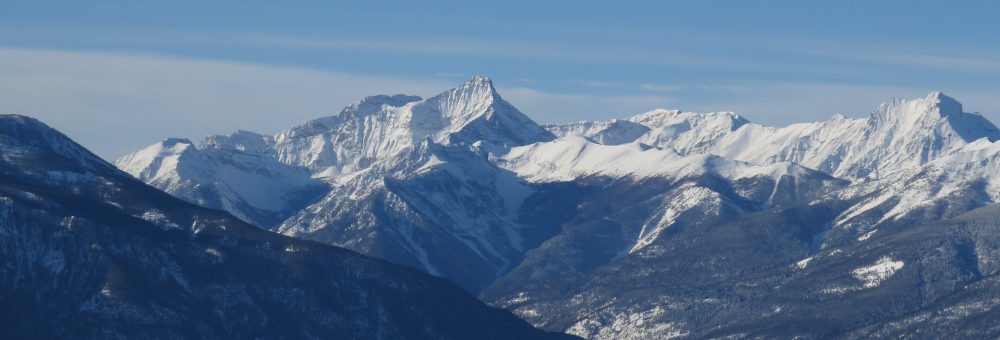
Haffner Creek, Mount Haffner (Kootenay National Park)
“A brilliant young Canadian named Harry Haffner, who has been responsible for a number of irrigation and power systems, as well as roads in Alberta and BC.”30
This is the first of two posts written to mark to centenary of the opening of the Banff-Windermere Highway on 23 June 1923. The second post, about James Wardle, will be out in two weeks.
Mount Haffner, a prominent mountain in Kootenay National Park, was named in December 1921 by the Geographic Board of Canada after Lieutenant Henry (Harry) John Alexander Haffner,1 a civil engineer in charge of the first survey and early construction of the Banff-Windermere Highway. Haffner died on the battlefield in Belgium on 30 May 1916 during the First World War.
Harry Haffner
Henry (Harry) John Alexander Haffner was born 21 September 1880 in Guelph, Ontario to parents John Haffner and Mary Elizabeth Foster.2 He had two older brothers, one elder sister, and would have a younger brother as well.3 The family moved from Guelph to Winnipeg before Harry was age three, where his father, John, went into business as a grain dealer,4 then an accountant,5 and finally into real estate.6
By 1901 Harry was a “student engineer”,7 and in 1904 received a Bachelor Science at McGill University.8 He also served for two years with the 90th Rifles Winnipeg (1899-1900).9
Early Engineer Career
Harry got a job out of University as an engineer with the CPR, and can be found working on a “ditch construction camp” in Alberta on the 1906 prairie census.10 There’s a very good chance, given the time frame, that these “ditches” referred to irrigation ditches then being put in by the CPR to aid in settlement. Harry quickly gained a reputation in Calgary as a civil engineer, and also travelled extensively through British Columbia, particularly to Victoria.
Sometime in summer 1909 Haffner moved from Calgary to Vancouver,11 where he got a job with Smith, Kerry, and Chase, a company specializing in hydro-electric and irrigation projects. Haffner went on as agent for the company to propose and construct a hydro-electric dam project on the Illecillewaet River near Revelstoke from 1909 into 1911,12 and to investigate an irrigation project in the Creston area in autumn 1910.13
Haffner is also mentioned on a 1910 irrigation scheme in Lumby in the northern Okanagan – in this case Haffner is referred to as, “the Calgary irrigation expert.”14 By spring 1911, Haffner was representing the BC Hydraulic Company in a proposal to electrify the city of Nanaimo and its outlying districts with both power and light,15 and that July presented plans he had prepared for the Victoria Harbour Railway Company to build a railway along the harbour in Victoria.16 A plan profile for the project was filed in December 1912.17
Windermere Ties
Amongst all of this, Haffner had developed ties in the Windermere area. In autumn 1907, while still based in Calgary, Haffner is mentioned as being “the engineer in charge of the irrigation survey” on the Columbia Valley Irrigated Fruit Lands Co property outside of Wilmer.18 This land development scheme aimed to use a series of flumes and canals to bring water down from Boulder Creek (now Bruce Creek) to irrigate the Toby Benches for the establishment of fruit farms.
Even while Haffner worked on projects around B.C., then, he was also closely involved in the CVI project for at least three years.19 When staying at a Nelson hotel in 1908, he reports his address as Wilmer: staying at the same hotel at the same time were B.G. Hamilton of Calgary, a future Invermere resident and in 1908 the secretary of a CPR irrigation manager, and E Mallandaine of Cranbrook, also heavily involved in irrigation schemes in Creston, and later the manager of the Columbia Valley Irrigated Fruit Lands Co in Invermere in 1911.20 Haffner’s name also appears in the 1910 BC Directory as a civil engineer in Wilmer (as well as a civil, hydraulic and irrigation engineer in Vancouver).21 At the time of his death, Haffner still owned 114 shares in the Western Agencies & Development Co, which was the parent company of the Columbia Valley Irrigated Fruit Lands Co.22

Harry Haffner (in the middle, leaning against the tent) at a survey camp in Dutch Creek in September 1907. This survey would have been part of work for the CVI.
Oswald A. McGuinness, “Survey Camp on Dutch Creek, Columbia Valley, September 10, 1907.” Windermere Valley Museum and Archives, A492.
The Banff-Windermere Highway
It is likely through this local connection that Harry Haffner was engaged in doing the initial survey of the Banff-Windermere Highway in the summer of 1911.23 Haffner was then still working for Smith, Kerry, and Chase of Vancouver,24 and was also “one of the best known engineers of the province.”25 In autumn 1911, immediately following his survey of the proposed Banff-Windermere Highway, Haffner was instructed to also make a survey of a road through the Upper Kootenay Valley to Canal Flats (roughly Settlers’ Road – he isn’t paid for this survey until the 1913/14 fiscal year).26

Survey work on the Banff-Windermere Highway, 1911. Windermere Valley Museum and Archives, A737,
Sometime in 1912, Haffner left his previous firm to start one of his own, becoming the senior partner in the engineer firm Haffner and Wurtele. His partner was John S.H. Wurtele, another graduate of McGill, with Haffner being based in Victoria, and Wurtele in Vancouver.27

1912 Advertisement for Haffner & Wurtele.
Henderson’s Greater Vancouver New Westminster and Fraser Valley directory 1912, Vol. 14 (Vancouver : Henderson Publishing Company, Ltd., 1912), p 222, https://dx.doi.org/10.14288/1.0366242
Construction began on the Banff-Windermere from the Windermere end in summer 1912, with Haffner and Wurtele being “in charge of all of construction work”28 (it looks as if Haffner was on the ground).29 A large part of the work that season was drilling and blasting out Sinclair Canyon to make room for an automobile road alongside the creek.

Construction work putting a road through Sinclair Canyon, 1912. Note the people and ladders up on the cliff! Windermere Valley Museum and Archives, A786.

Harry Haffner’s road through Sinclair Canyon.
“Man standing on road in East Kootenay mountains,” n.d., Krebs studio, Accession No 14304, Vancouver Public Library.
During the 1912 construction season John Murray Gibbon, then head of the CPR’s publicity department, recalls motoring south from Golden to check out the work, reporting that, “the driver of the car was also its owner and he was the superintending engineer, a brilliant young Canadian named Harry Haffner, who has been responsible for a number of irrigation and power systems, as well as roads in Alberta and BC. … Several miles of road had been completed, all except the surface finish, and at the moment of our coming the gangs were at work clearing the right of way and throwing a bridge over Sinclair Creek” (this was likely the bridge in Sinclair Canyon). Gibbon goes on to comment favourably towards, “the leadership of a bright, sturdy handsome foreman [Haffner].”30 This work on the Banff-Windermere continued through 1913.
The War Cuts Things Short
Haffner and Wurtele continued as consulting engineers for other projects as well. Newspapers report their submitting a design for a bridge across the harbour in Vancouver, in March 1913,31 and for submitting plans for a hydroelectric power project on the Elk River, this time while (once again) acting as agents for the BC Hydraulic Power Co.32
All of this engineering work was rather upended in 1914 with the start of the First World War. Haffner joined up quickly as an officer with the 72nd Seaforth Highlanders, being appointed as a “provisional lieutenant” in November 1914 “pending official registration.”33 He was mobilized and posted to Nanaimo in December before being transferred to the 48th Battalion of the Canadian Expeditionary Force in February, and sailing overseas at the beginning of June 1915.34 He was reportedly “in charge of the machine gun section” of the 48th,35 and became part of the instructional staff of the machine gun school at Shorncliffe, training post of the Canadian Army, in October 1915.36

A very poor quality photo of Lieut Harry Haffner. “Local Officer is Killed in Action,” The Daily Colonist (Victoria B.C.), 10 June 1916, p 5, https://archive.org/embed/dailycolonist58y156uvic
Haffner was transferred to the 8th Field Company Canadian Engineers (Shorncliffe), arriving in Belgium in mid March 1916.37 He handwrote his will just a couple of weeks later, on 30 March 1916, and on 30 May 1916 he died of wounds at the No 10 Canadian Field Ambulance (this was during fighting in Ypres).38 According to a letter later sent to Haffner’s brother from his commanding officer (Lieutenant Commander Anderson), Harry was standing in a trench on May 29 when he was struck by a bullet, and died some hours later at a field dressing station.39 He is buried at the Brandhoek Military Cemetery in Belgium.40

Harry Haffner wrote his will in the trenches in Belgium.
[Will of H.J. Haffner, 30 March 1916], Henry John Alexander Haffner estate, No 8921, Estate files (no 8921-9095), years 1916-1917, Provincial Archives, Winnipeg. FamilySearch Database, Canada, Manitoba Probate Records, 1871-1930, img 21 of 2955.; ‘In the Matter of the Estate of Henry John Alexander Haffner Deceased,’ The Vancouver Daily Province, 10 March 1917, p 27, https://familysearch.org/ark:/61903/3:1:33SQ-G1YD-RKK?cc=1987562&wc=M69Z-BWL%3A265412501%2C265412002%2C266072601
Following his death, Harry’s elder brother Ernest served as executor of his will. Haffner accorded all of his property to his sister (Kate E), and other money to his mother and father half each.43
Windermere Property
Amongst his estate, H.J. Haffner held a variety of properties in the Windermere Valley. There were two lots in the Invermere townsite, the location of which isn’t entirely clear (they are noted as Lots 7 & 8), but which are listed as having “no value” on Haffner’s probate.44
He also apparently owned partial interest in multiple acreages in the East Kootenays. These included a two-thirds interest in the three lots just south of Madias Creek (Sub Lots 131, 131A, and 115 of Lot 4596). Haffner had previously applied for an irrigation license for these properties in May 1911, planning to take water from Windermere Creek to be stored in Fish Lake above Tegart’s Ranch.45
Haffner held a half interest in Lot 8107 near Fort Steele as well, along with another half interest in Sub Lot 162 of Lot 4596, located behind Windermere east of the Golf Course.46 It’s unclear what was done with the majority of this property, but this last lot remained under the ownership of “H.J. Haffner” until at least 1926, when it is listed by the Province for unpaid taxes ($458.61).47
Mount Haffner
Following the war, a party of people in Calgary approached the Geographic Board of Canada with the result being that one of the prominent peaks on the Banff-Windermere Road was named after Haffner in December 1921 (this was confirmed in the 18th Geographic Board Report in March 1924).48 The location of the peak was chosen in direct relation to Haffner’s work on the road, both “making the first complete survey of this road [and having]… charge of some of the early construction work.”49 By the time the completed Banff-Windermere Highway was opened, on 23 June 1923, Mount Haffner had been named, and articles celebrating the completion of the road mention Haffner, “the first engineer” in relation to that original survey line back in 1911.50
Haffner was the engineer who got the work started on the Banff-Windermere Highway, but it took another young engineer to finish it. That engineer, James Wardle, is the subject of the next post – he and Haffner are a rather interesting study in compare and contrast!
See Also
John Murray Gibbon
Sinclair Canyon
Footnotes
↩ https://dx.doi.org/10.14288/1.0308108
 In The Windermere
Sorry I know I could have done this cleaner, but I am under a time crunch right now. Just working with some material of George Hope Johnson in the Cranbrook Herald, March 18, 1925 (p7) and thought you might find this interesting, if you don’t already know it.
“I pre-empted a half section close to where is now the small town of Windermere. The survey was made by Aylmer and was the first to be made in the district. Needless to say I located a choice piece of land and recorded a right to 250 miner’s inches of water, for irrigation purposes, on the adjoining creek.”
I am finding Johnson very interesting, particularly hi9s insights into people like the Galbraiths and Wm. Fernie.
Derryll White
LikeLike
Yes, Johnson is definitely a character! The lot he’s referring to is Lot 108 in Windermere: you can see his original Crown Grant application and such here: https://familysearch.org/ark:/61903/3:1:3QS7-89WZ-TQF3?cc=2052510&wc=M738-W68%3A351099401%2C351495401
Johnson’s also got his own interesting history in Western Canada – he was involved in the CPR ‘riots’ in the Beavermouth/Rogers Pass area during construction, and pops up in the Horsethief Creek story as well. The man got around! If you have access, he wrote a bunch for the Calgary Herald in the 1920s – interesting stories in there, not always true 🙂
LikeLike
During the time of the construction of the Banff-Windermere Highway, Tex Vernon-wood was for some time the Park Warden at Massive, near Lake Louise/Laggan. He and his wife Joan let their children get only so far from the warden cabin, and a large pine tree markied the boundary. The “engineeer in charge” of the highway works – either Haffner or Wardle allowed the road to have a”traffic island” in the middle of the road to conserve that tree, as recounted by Tex’s third daughter Dorothy (my mother). The tree was still therein the 1950s; – I saw it every time we passed on the “old road” of the B-W Highway, on our numerous trips between the Horsethief Ranch and Banff.
LikeLike
This is such a great story!! I’m going to be looking for a treed traffic island now in my various research adventures on KNP. Thanks for sharing Harry 🙂
LikeLike